How to Read Your Lawn for Grub Damage on Cape Cod (Before It's Too Late)
By Jim | Lawn Care Tips
Come fall on Cape Cod, our phones start ringing with the same question: a lawn was green all August, then a patch of it turned brown almost overnight — and no matter how much the homeowner waters it, it won’t come back.
Drought stress causes that sometimes. So does disease. But at this point in the season, grubs deserve a spot near the top of the suspect list.
Damage from grubs tends to show up in late summer and early fall — right around when most homeowners chalk up a struggling lawn to the season simply winding down. Recognizing the real cause early gives you a shot at catching it, repairing what’s already gone, and heading off a repeat next year.
Below is a rundown of what your lawn is actually trying to tell you.
What’s Happening Below the Surface
Several beetle species — Japanese beetles among them — lay the eggs that become white grubs. Those eggs go into lawns over the summer, and once they hatch, the larvae start chewing on grass roots just beneath the surface.
The effects of that feeding tend to surface by late summer or early fall. Once enough roots are gone, patches of turf stop holding onto the soil underneath. You’ll see grass go yellow or brown regardless of how well it’s being watered.
Cape Cod lawns are fighting an uphill battle to begin with: sandy soil drains fast and leaves turf exposed during hot, dry spells. Well-rooted, healthy grass can shrug off a fair amount of grub feeding. But turf already weakened by drought, thin soil, compaction, or other stressors can show damage from a far smaller grub population.
In other words, grub counts alone don’t tell the whole story. How the lawn is holding up matters just as much.
Telling Grub Damage Apart from Drought Stress
Come September, brown grass could mean late drought stress, a fungal issue, or grubs — and each calls for a different fix.
A quick pull test is usually the simplest starting point.
Take a handful of grass and give it a gentle tug.
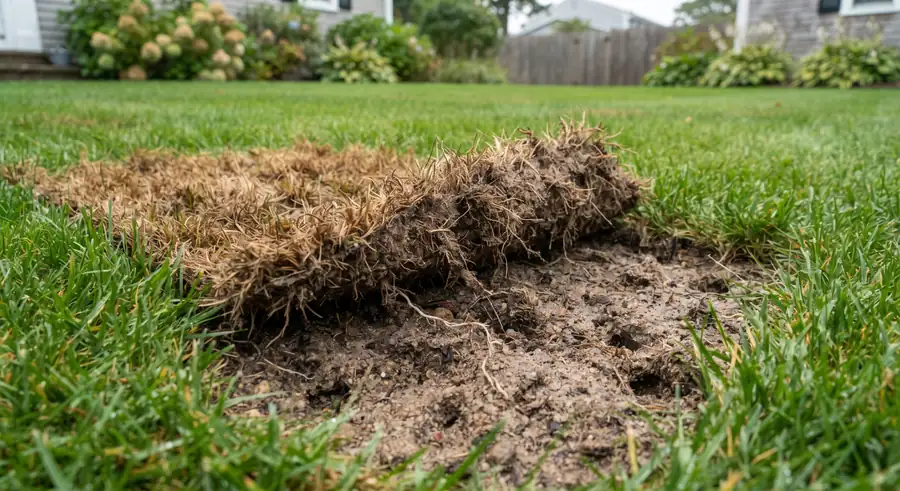
If it comes up unusually easily — peeling back almost like a strip of loose carpet — that points strongly toward grubs. Heavy root feeding leaves almost nothing anchoring the turf down.
Grass suffering from drought, by contrast, typically stays put when you pull, even though it looks dry and brown, because the root system is still intact.
A handful of other clues can also suggest grubs are at work:
- Turf that feels spongy or loose. Walk over the affected spot. Ground with serious root damage often feels squishy or unstable rather than firm.
- Patches that look ragged, not uniform. Grubs rarely damage a whole lawn evenly — expect irregular, scattered brown areas instead.
- Digging from skunks, birds, or raccoons. Grubs are a food source for these animals. Overnight damage from something tearing up sections of turf is worth investigating.
- No improvement despite watering. A brown patch that keeps declining even with proper watering suggests the trouble lies underground, not in a lack of moisture.
Any one of these signs on its own isn’t proof. Confirming grubs means getting a look under the turf itself.
Doing the Pull-Back Check
Before deciding on next steps, verify what’s in the soil.
Pick an edge of the damaged patch and cut back about a square foot of turf. Peel the grass back and examine the first few inches of soil underneath.
White grubs show up as pale, C-shaped larvae with a darker head. By this point in the season, most are big enough to spot without much trouble.
Tally what you find.
Just a handful of grubs: Usually nothing to worry about — a healthy lawn can absorb that level of feeding without visible harm.
Roughly 5 to 10 per square foot: Worth watching closely, since lawns already under stress can start showing damage even at this level.
10-plus per square foot: A sizable population, especially paired with turf that’s already visibly struggling.
No single threshold applies across the board. Damage tolerance varies by grub species, and a dense, healthy lawn can absorb more feeding than one that’s already struggling.
We weigh both pieces of the puzzle — the grub count itself and the condition of the lawn above it.
Your Options Heading into Late September
Treatment gets trickier the later into September you go.
Curative products work best on grubs that are still small, still feeding, and still near the surface. As the season progresses, the larvae get bigger and start burrowing deeper as the soil cools.
So jumping straight to a treatment isn’t the right first move.
Verify grubs are actually the cause.
Brown turf calls for the pull-back check first. Applying a grub treatment won’t do anything if drought, disease, compaction, or something else entirely is the real culprit.
Weigh whether treatment is still worth it.
Curative options can still work while grubs are feeding close to the surface, but their effectiveness fades as the larvae mature. Late in September, the call comes down to what’s actually in the lawn, how much damage exists, current weather and soil conditions, and where the grubs are in their development.
Fix the damage that’s already done.
Killing off grubs won’t revive turf that’s already dead. Spots with severe root loss will likely need reseeding or other repair work.
Early fall happens to be a strong window for establishing new grass here — soil retains enough warmth for germination, while milder air temperatures go easier on young seedlings.
Keep track of where it happened.
A spot with a history of grub trouble is worth flagging. Lawns that keep having the same problem are good candidates for closer monitoring and, when it makes sense, preventive treatment the following year.
Why Prevention Wins in the Long Run
For lawns with a recurring grub problem, staying ahead of it beats waiting for the next round of brown patches.
Preventive treatment aims to have protection in place right when newly hatched grubs are smallest and most vulnerable.
Getting the timing right is everything.
Application windows vary by product — some go down in spring, others closer to when beetles lay eggs in early summer. The right call depends on the product, the site, and which grub species you’re dealing with.
That’s part of why we steer away from treating every property on one fixed schedule.
Prevention isn’t only about chemical treatment, either.
Deep, healthy turf handles moderate grub feeding far better. Mowing correctly, watering appropriately, aerating when it’s needed, and overseeding sparse spots all build a stronger root system.
Given how fast Cape Cod’s sandy soil dries out, keeping the lawn strong through summer can make a real difference in how it holds up once stress season hits.
When to Reach Out
Grass turning brown, pulling loose from the soil with little effort, or drawing skunks and birds overnight isn’t automatically a watering problem.
Peel back a section of turf and see what’s underneath.
If the grub count is high, the damage covers real ground, or you’re just not sure what you’re looking at, reach out and we’ll take a look.
Our in-house fertilization specialist can pin down what’s actually causing the damage — then map out whether treatment, repair, or a prevention plan for next season makes the most sense.
Related reading: It’s Aeration & Overseeding Season on Cape Cod · When to Do Fall Cleanup on Cape Cod
— The Sears Landscaping Team
Not sure if it’s grubs? Send us a photo and we’ll take a look.
John G. Sears & Son Landscaping | Est. 1931 | Cape Cod, MA